.jpg)



FROM HANSOM CABS TO ELECTRIC TAXIS: How regulation, technology and design shaped the taxi trade from the 17th century to the electric era

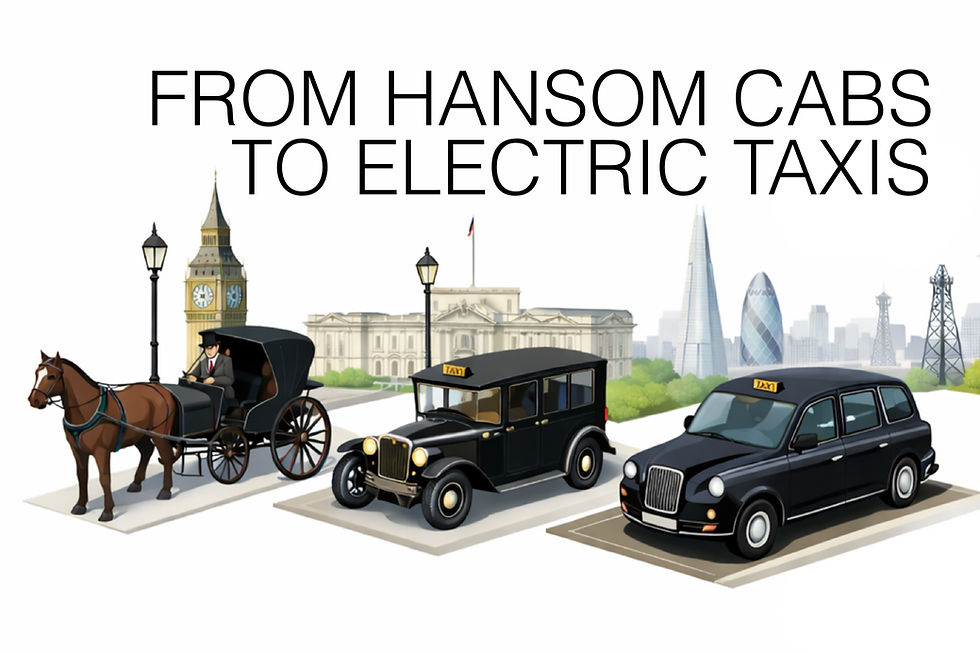

The modern UK taxi industry is the product of centuries of regulatory control and repeated waves of technical change. From horse-drawn hackney carriages to plug-in hybrid black cabs, each shift has altered both the passenger experience and the working life of drivers.
The regulated horse-drawn era (1600s to late 1800s)
Hackney carriages began operating as vehicles for hire in London during the early 17th century. Their rapid growth created congestion and disorder, prompting early state intervention. By the mid-1600s, limits were placed on vehicle numbers and formal licensing introduced.

This period established a defining feature of the UK taxi trade: regulation tied to public interest. Licensed drivers were subject to fare controls and conduct rules, while passengers gained protection against overcharging and unsafe vehicles.
The introduction of the hansom cab in the 1830s marked a technical step forward. Lighter, faster and more manoeuvrable than earlier carriages, hansoms improved journey times and allowed drivers to complete more fares per shift.
By the Victorian era, licensing frameworks had expanded beyond London. Legislation such as the Town Police Clauses Act enabled towns and cities across England and Wales to regulate hackney carriages locally, embedding taxis into municipal transport planning.
The professional identity of the cab driver was reinforced in 1865 with the introduction of The Knowledge. Requiring mastery of London’s streets, it ensured navigation skill rather than vehicle technology defined service quality.
Motorisation and the birth of the taxi (1890s to 1920s)
The first motor taxis arrived in London in 1897, initially powered by electricity. Walter Bersey’s electric cabs offered silent, fume-free travel and briefly attracted public interest, but limited range and poor reliability led to their withdrawal within two years.
Petrol-powered taxis followed from 1903 and quickly displaced horse-drawn vehicles. They extended working range, reduced journey times and allowed drivers to operate longer shifts without animal care costs.
A pivotal regulatory change came with the taximeter. Mandated in London from 1907, it standardised fares and removed disputes over pricing. For passengers, it delivered transparency. For drivers, it provided predictable income under regulated tariffs.
Vehicle standards tightened during this period. Official fitness conditions imposed requirements such as tight turning circles and specific body layouts, shaping the distinctive design lineage of London taxis.
By the early 1920s, motor cabs dominated urban streets. Horse-drawn hackney carriages continued in small numbers but were in terminal decline.
Post-war consolidation and the black cab identity (1940s to 1980s)
The post-war years saw the emergence of the modern black cab. Purpose-built vehicles replaced adapted saloons, reflecting tighter regulation and the need for durability under heavy urban use.
The Austin FX3, introduced in 1948, set the template. Diesel engines, robust chassis design and compliance with London’s exacting standards made it a workhorse of the trade.
This design reached its most recognisable form with the Austin FX4 in 1958. Produced in various updated forms until the late 1990s, it became synonymous with London street transport.

For passengers, consistency was the defining benefit. Any licensed cab offered similar seating, access and driver expertise. For drivers, the FX4’s longevity reduced capital costs but also slowed innovation.
Regulatory developments continued. Advertising on taxis was legalised, creating a supplementary income stream. Accessibility requirements were gradually introduced, culminating in wheelchair-accessible vehicles becoming standard.
By 2000, the entire London taxi fleet was accessible, reinforcing the taxi’s role as part of the city’s public transport system rather than a premium niche service.
Digital disruption and fleet renewal (1990s to 2010s)
The retirement of the FX4 coincided with wider technological change. New TX-series vehicles introduced modern safety systems and emissions improvements while retaining traditional layouts.
The most disruptive shift, however, came from outside vehicle design. Mobile phone booking and later smartphone apps transformed how passengers accessed services.
App-based operators expanded rapidly, increasing vehicle numbers and intensifying competition. Licensed taxi drivers faced falling trip volumes and downward pressure on earnings.
The response was partial adaptation. Card payments became mandatory, app-based booking for black cabs expanded, and operational efficiency improved. The core regulatory model, however, remained unchanged.
This period reshaped the job itself. Route knowledge remained important, but digital tools became unavoidable. The taxi trade increasingly had to justify its regulatory burden through service quality rather than exclusivity.
Electrification and environmental regulation (late 2010s to present)
Air quality policy triggered the next structural change. From 2018, newly licensed taxis in London were required to be zero-emission capable.
The launch of the LEVC TX marked the most significant vehicle shift since the FX4. A plug-in hybrid with electric-only capability, it combined regulatory compliance with operational flexibility.
For passengers, benefits included quieter journeys, lower local emissions and improved onboard features. For drivers, fuel savings and charge exemptions offset higher purchase costs.
Pure electric taxis followed, reintroducing a technology last seen in the 1890s, this time with mature battery systems and supporting infrastructure.
By the mid-2020s, more than half of London’s licensed taxis were zero-emission capable, with further transition expected as older diesel vehicles are retired.
A trade shaped by continuity and constraint
Across four centuries, UK taxis have evolved through controlled change rather than disruption alone. Legislation has consistently defined who can operate, how vehicles are built and what passengers can expect.
Each technical shift, from the taximeter to the electric drivetrain, altered daily working practices but reinforced the taxi’s role as a regulated public service.
The industry now operates in a hybrid space: traditional licensing and standards alongside digital booking and low-emission technology.
That balance between continuity and adaptation remains the defining challenge as the next phase of taxi history unfolds.