.jpg)



Is there too much taxi regulation, or not enough? Why the taxi and PHV industry wants smarter rules, not simply more of them

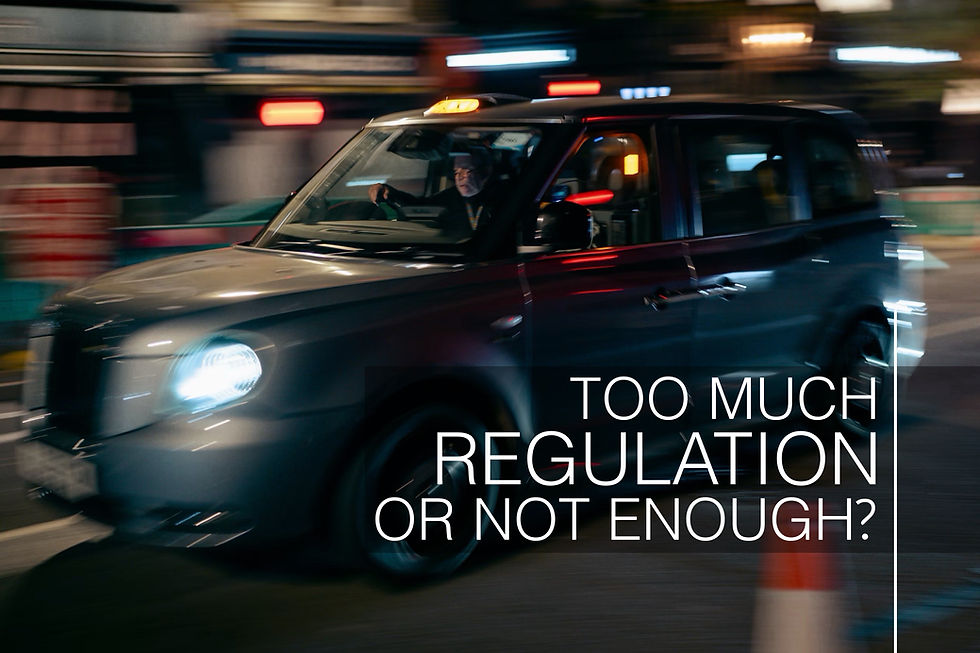

The taxi and private hire industry has never argued against regulation. In fact, licensing is one of the key reasons passengers continue to trust licensed transport. Criminal record checks, medical assessments, safeguarding training, vehicle inspections and insurance requirements all provide reassurance that licensed drivers and vehicles have met standards designed to protect the travelling public. Without those safeguards, confidence in the industry would quickly diminish.
The debate today is therefore not about removing regulation. Instead, it is about whether regulators are focusing their efforts in the areas that deliver the greatest benefit. Reporting over recent years has highlighted a growing feeling across the trade that while important safety standards remain essential, some local authorities are introducing increasingly detailed licensing requirements that add cost without always producing measurable improvements in passenger safety.

Professional drivers mostly support that regulation is part of the job. Most recognise that licensing standards distinguish taxis and private hire vehicles from unregulated transport. Those standards help protect vulnerable passengers, improve accountability and provide enforcement officers with the powers needed to deal with unsuitable drivers or unsafe vehicles. Few within the industry would argue that these protections should be weakened.
However, concerns begin to emerge when regulation appears to become excessive in some areas while other long-standing issues receive comparatively little attention. Many drivers believe the industry has reached a point where the balance has shifted away from tackling the biggest risks towards refining smaller policy details that have less impact on public confidence or day-to-day safety.
One example could be the growing number of councils introducing mandatory CCTV requirements. Supporters argue that cameras protect both passengers and drivers, provide valuable evidence when complaints arise and discourage criminal or abusive behaviour. These are genuine benefits that many drivers recognise, particularly those working late-night economy shifts where disputes can occasionally occur.
The debate is whether mandatory installation in every licensed vehicle represents a proportionate response. That is arguably over regulation. The topic has seen a wide variation of stances taken between licensing authorities, with some councils requiring CCTV in every vehicle while neighbouring authorities see no need for compulsory systems. For drivers, the cost of purchasing equipment, maintaining it and complying with data protection rules can be significant, particularly when there is little evidence that mandatory schemes consistently outperform voluntary adoption.
Vehicle age limits represent another area where questions over proportionality continue to grow. Many licensing authorities require vehicles to be replaced once they reach a specific age, regardless of their overall condition. The objective is understandable, with newer vehicles generally producing lower emissions and incorporating more modern safety technology. Encouraging cleaner and more reliable fleets is a legitimate public policy goal.
Yet many drivers question whether age alone should determine whether a vehicle remains suitable for licensing. A well-maintained vehicle that consistently passes rigorous inspections may still provide years of safe and reliable service. TaxiPoint has frequently reported on councils adopting very different age policies despite licensing similar vehicle types. Many within the industry, and even Government guidance, believe regular mechanical inspections provide a far better assessment of safety than an arbitrary age limit.
While councils continue refining local licensing conditions covering issues such as emissions, signage, testing intervals and vehicle specifications, many industry representatives believe the greatest regulatory gap exists elsewhere. The issue most frequently raised is cross-border private hire working, where vehicles licensed by one authority can legally undertake bookings in another area provided the booking is accepted by their licensed operator.
Concerns surrounding cross-border hiring, particularly where large numbers of vehicles licensed by authorities with lower fees or different licensing standards spend most of their working lives operating elsewhere.
Although entirely lawful under current legislation, many councils argue the arrangement undermines local licensing policies and limits their ability to influence standards on vehicles working almost exclusively within their own communities.

This issue has become central to discussions surrounding future taxi legislation. Trade organisations, licensing authorities and industry representatives have repeatedly argued that reforming cross-border hiring would do more to restore confidence in the licensing system than introducing further local requirements affecting drivers who are already meeting high standards. Recent discussions surrounding the proposed Taxi and Private Hire Bill have once again placed cross-border reform firmly on the political agenda.
National licensing standards are another area where many believe regulation should become stronger rather than weaker. Although statutory guidance exists, significant differences remain between councils on medical standards, knowledge tests, safeguarding requirements and vehicle policies.
A more consistent national framework could reduce confusion for drivers, simplify enforcement and give passengers greater confidence that similar standards apply regardless of where a vehicle is licensed. Local authorities would still retain important enforcement responsibilities, but fundamental safety expectations could become more uniform across England, helping reduce the postcode lottery that currently exists in several aspects of licensing.

Ultimately, the industry’s argument is not that regulation has gone too far or that it should be rolled back. Rather, many believe regulatory effort has become uneven. Significant attention is often devoted to highly detailed local licensing conditions while larger structural issues, particularly cross-border working and national consistency, remain unresolved despite years of debate and evidence of change required.
Good regulation will always be essential because it builds trust between passengers, drivers and licensing authorities. The challenge now is ensuring regulation remains proportionate, evidence-based and focused on the areas where it delivers the greatest public benefit. For much of the taxi and private hire industry, the future lies not in more regulation or less regulation, but in regulation that addresses the right problems and not introduced just for the optics.