.jpg)



Peers clash over taxi accessibility rules as Lords REJECT amendment to enforce Equality Act standards

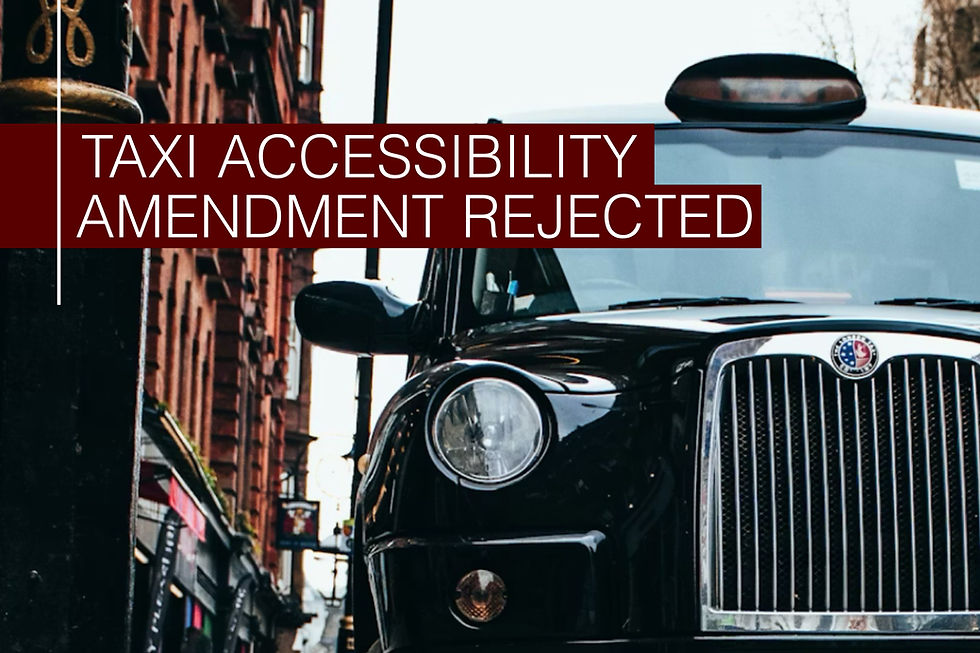

A House of Lords debate on the English Devolution and Community Empowerment Bill exposed deep divisions over how and when to enforce long-standing taxi accessibility provisions, after peers REJECTED a proposed amendment aimed at mandating nationwide wheelchair access standards within three years.
Amendment 268, tabled by Conservative peer Lord Borwick, sought to require taxis to meet minimum accessibility requirements already set out in the Equality Act 2010, arguing that successive governments had failed to implement powers first introduced more than three decades ago. The proposal was defeated following a division, with 46 votes in favour and 117 against.

Opening the debate, Lord Borwick framed the issue as one of long-delayed enforcement rather than new regulation. “My amendments would not create new law; the laws were passed in 1995 and 2010,” he said. “All we are doing is making sure that the law is enforced.”
Drawing on his experience as a former chief executive of Manganese Bronze Holdings and long-time advocate for accessible taxis, Borwick highlighted the personal impact of accessible transport. He described receiving “an extraordinarily powerful letter” from a teenage wheelchair user who, for the first time, was able to travel independently using an adapted taxi. “What we had done was to enable the girl to be free: a very valuable freedom, the freedom to travel,” he said.
House of Lords vote highlights ongoing divide over national standards versus local flexibility in taxi accessibility policy
However, he criticised successive administrations for failing to act on legislative provisions that allow ministers to mandate accessibility standards. “The department has two choices if it does not like legislation: to obey it or to propose to repeal it,” Borwick said. “The extra choice taken by the DfT is to leave it in place and hope that everybody has forgotten it.”
Support for the amendment came from across the House, with peers emphasising the operational and social impact of limited accessible taxi provision, particularly outside major urban centres. Crossbench peer Baroness Grey-Thompson pointed to stark regional disparities, noting that in parts of the north-east of England “it is almost impossible to get an accessible taxi”. She added that securing transport for a visiting wheelchair user “took many hours over several days”.
Grey-Thompson also highlighted broader system pressures, including reliance on inaccessible rail replacement services and potential changes to Motability support, which could increase demand for accessible taxis. “Accessible taxis are a really important part of equal access for disabled people,” she said.
Lord Shinkwin called the issue a failure of enforcement that risks reversing progress on disability equality. “The fact that we are considering them this evening makes me sad,” he said, adding that the lack of action over 31 years had contributed to “a culture of renewed discrimination and impunity”.
He questioned the broader policy signal, stating: “Why should I, as a disabled Member of your Lordships’ House, have to wait any longer for taxis to be made accessible just because I am disabled? I am done with waiting.”
Several peers challenged the Government’s rationale for resisting a uniform national standard. Lord Young of Cookham dismissed concerns over implementation timelines, noting that the amendment allowed three years for compliance. “To plead the lack of time is not a good excuse,” he said, referencing standard consultation periods of 12 weeks.
He also questioned arguments around flexibility, pointing to London’s long-standing single accessibility standard. “Within London, we have the same range of disability as exists elsewhere in the country,” he said, adding that no evidence had been presented to suggest such a model breached equality obligations.
Despite cross-party backing, including support from the Green Party and Liberal Democrats in principle, concerns were raised about the amendment’s scope. Liberal Democrat transport spokesperson Baroness Pidgeon noted that hackney carriages represent less than 20% of the combined taxi and private hire fleet, meaning the proposal would not address accessibility across the wider private hire sector.
Responding for the Government, Transport Minister Lord Hendy acknowledged the historic failure to implement accessibility provisions but argued that the market had fundamentally changed. He highlighted the growth of private hire vehicles, which now account for around 82% of the combined fleet in England, exceeding 300,000 vehicles.
“The taxi has been joined across England by much increased numbers of licensed private hire vehicles,” Hendy said, warning that the amendment’s focus solely on taxis would limit its effectiveness, particularly in rural areas where private hire dominates.
He also raised concerns over cost implications for drivers, many of whom are self-employed. Mandating wheelchair-accessible vehicles across the taxi fleet would impose “a significant cost of some magnitude for thousands of self-employed drivers”, he said, potentially leading to drivers exiting the sector or switching to private hire licensing to avoid compliance costs.

The Minister further argued that a uniform wheelchair-accessible fleet may not meet the full spectrum of disability needs. Citing advice from the Disabled Persons Transport Advisory Committee, he said mixed fleets offer a more inclusive solution for both wheelchair users and ambulant disabled passengers.
“If accepted and implemented, this amendment would realistically result in fewer taxi services being available across the country,” Hendy said, warning of “longer wait times” or even “no supply” in some areas.
Instead, the Government plans to introduce national minimum standards through secondary legislation, including mandatory disability equality training for drivers and booking staff, alongside requirements for local licensing authorities to develop inclusive service plans based on demand.
The debate highlights a broader regulatory tension within the taxi and private hire sector, particularly as policymakers seek to balance accessibility improvements with economic pressures on drivers and structural changes driven by app-based services.
For the industry, the outcome signals that immediate nationwide mandates on accessibility are unlikely, with the Government favouring a phased, locally tailored approach. However, the strength of cross-party support for Borwick’s amendment suggests that pressure for more decisive action on accessibility standards is likely to continue as wider taxi and private hire reforms progress.
RELATED NEWS STORY: