.jpg)



DODGING DEBT AND EARNING EARLY: Why are young Londoners swapping university for the Knowledge of London?

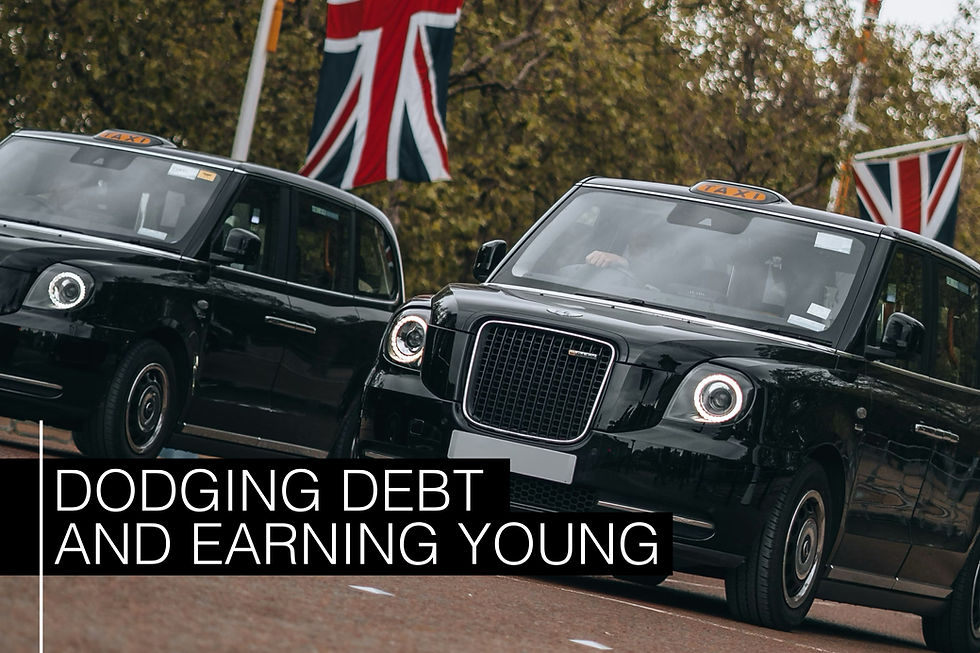

An emerging trend sees some of London’s school-leavers forgo university to train as black cab drivers. Motivated by the prospect of avoiding tens of thousands of pounds in student loans and entering a well-paid profession in their early 20s, more young Londoners are opting to tackle the legendary “Knowledge of London” examination right after finishing their A-levels.
For an increasing number of applicants looking to enter the job market, student debt is increasing and job opportunities for youngsters remain thin on the ground, making the direct route to self-employment through the Knowledge increasingly attractive.

University tuition fees in England run up to £9,250 per year, leaving many graduates with over £50,000 of debt on average. By contrast, a licensed London cabbie incurs no such burden and can begin earning immediately upon qualification. Some experienced black cab drivers can earn upwards of £500 in a single day by putting in long shifts, according to some cabbies speaking to The Times. For an ambitious 18-year-old, they can weigh up spending a few years learning London’s streets instead of paying for a degree, and potentially start bringing in serious income by age 21.
Economic pressures are reinforcing this mindset. The UK’s entry-level job openings have fallen to their lowest level in five years , and competition for graduate roles is fiercer than ever. Recent data showed nearly 1.2 million applications chasing just 17,000 graduate jobs in the country during 2023/24.
Faced with soaring student debt and a cutthroat graduate job market, a growing number of 18-year-olds in the capital are choosing the Knowledge of London taxi test over university to fast-track a lucrative career
The Knowledge of London has a storied reputation as one of the world’s toughest exams for drivers. Candidates must memorise thousands of streets and landmarks within a six-mile radius of central London , all without GPS assistance, and prove their mastery in a series of one-on-one oral tests.
Historically it took three to four years of intensive study to pass . However, recent reforms by Transport for London (TfL) have sped up the path to qualification by condensing the landmarks that can be tested to a set 6,000 point list. This has helped cut the average completion time from 5¼ years in 2020 to roughly 3 years today. In fact, one determined trainee finished in just two years at age 20 and then waited until his 21st birthday to receive his licence (21 being the minimum age to drive a taxi in London). This means a teenager who begins the Knowledge at 18 could conceivably be working as a cab driver by the time their peers finish university.
Official figures confirm a resurgence of interest in the taxi trade, driven in part by younger entrants. Applications to become a licensed London taxi driver hit a decade high in 2025, rising from 440 in 2022 to 742 by late 2025 - a 68.6% jump . As of November 2025, approximately 1,390 candidates were actively studying for the Knowledge across the city. Industry insiders highlight a “clear shift towards younger people taking up The Knowledge” in recent intakes.
TfL recently noted a 20-year-old from Bromley as one of the latest to pass the exam in 2025. He will officially join the ranks as soon as he turns 21 . Such examples highlight the new pipeline of drivers emerging straight out of A-Level education. Helen Chapman, TfL’s Director of Licensing and Regulation, said the renewed youth interest “reflects the enduring prestige of becoming a licensed London taxi driver”.
The increase in younger drivers could bring long-term benefits to London’s transport sector. The black cab fleet has shrunk dramatically from about 22,000 licensed taxis in 2024 to only 14,000 in 2025. Younger drivers are helping to fill this gap and keep the iconic black cab a fixture on London’s streets. On the other side of the equation, universities and the broader education sector may feel the impact if this trend grows. With average graduate debt around £53,000 in England , this shift could force universities to compete harder for students and better justify the value of a degree.
For now, the choice by this rising cohort of young Londoners to pursue The Knowledge over university is a pragmatic response to financial and job market pressures. Their entry brings much-needed youth into an ageing driver pool and challenges the notion that a degree is the only route to a stable, well-paid career.