.jpg)



Government proposes major worker status reforms that could affect private hire drivers and ride-hailing operators

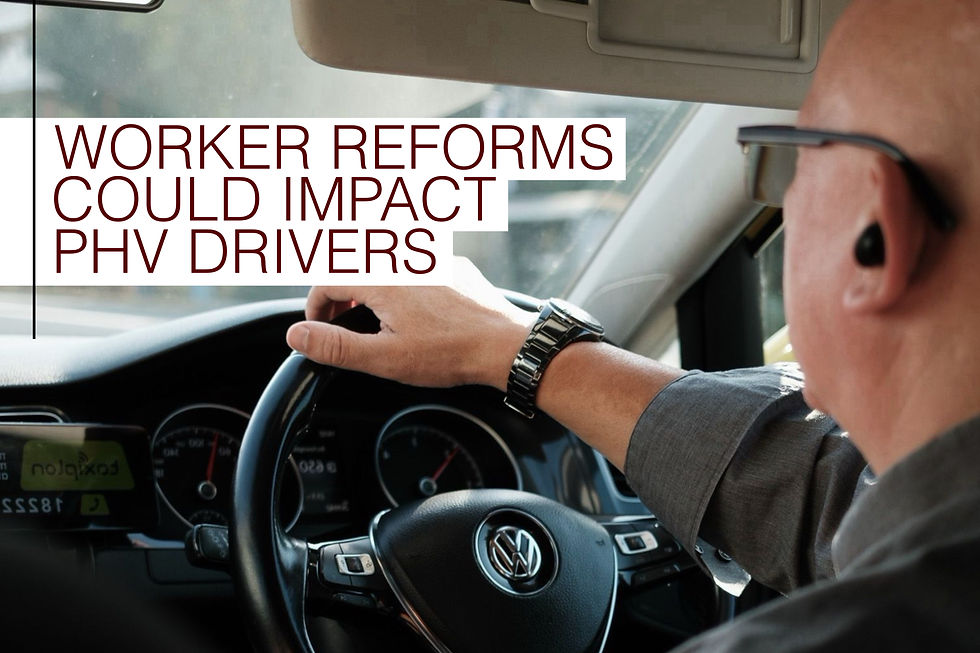

The Government has launched a consultation on employment status reforms that could have significant consequences for private hire drivers, ride-hailing platforms and businesses engaging self-employed workers.
The Department for Business, Innovation, Science and Trade published the proposals, seeking views on changes intended to prevent businesses incorrectly classifying workers as self-employed to avoid employment obligations.

Private hire drivers are specifically identified in the 47-page consultation document as part of a wider group whose working arrangements may leave some individuals without statutory employment protections.
The Government is considering changing the legal test used to determine whether someone qualifies as a worker, placing greater emphasis on the level of control exercised by a business.
Under existing arrangements, the requirement for an individual to provide services personally plays an important role in determining worker status.
Contractual provisions allowing individuals to send substitutes can influence that assessment, although courts also examine how the working relationship operates in practice.
Ministers are proposing to reduce the weight given to personal service requirements where other evidence indicates that a business exercises substantial control over an individual’s work.
The consultation also proposes introducing a presumption of worker status in certain employment tribunal proceedings.
This would reverse the existing burden of proof in relevant disputes, requiring the business engaging an individual to demonstrate that the person is not a worker.
The proposed presumption would apply to rights associated with worker status, including holiday pay and workplace pension access. It would not automatically establish employee status or determine whether an individual had received the correct payments.
The Government is also considering stronger financial penalties for businesses that repeatedly fail to recognise workers’ employment status.
Under the proposals, repeated misclassification following an earlier tribunal ruling involving workers in broadly similar circumstances could become an aggravating factor when determining penalties.
The consultation identifies existing tribunal penalty powers ranging from £100 to £20,000 per claim. The proposed amendment would make repeated failures to recognise employment status an explicit consideration when those powers are exercised.
Another element concerns the role of the Fair Work Agency, which began operating in April 2026.
Ministers are examining how the agency could help establish employment status and support enforcement where businesses are suspected of incorrectly classifying individuals.
The consultation also considers additional protections for genuinely self-employed workers, including written statements setting out contractual terms, extended blacklisting protections and measures concerning health and safety.
Written statements could include information about the work being undertaken, payment arrangements, contract duration and termination provisions.

The Government has not decided whether such requirements should apply to all self-employed individuals or only particular categories of working arrangements.
For private hire operators, the proposals could have sizeable implications for driver contracts, employment-related liabilities, record-keeping and the financial consequences of incorrectly determining employment status.
The legal position would continue to depend on the applicable legislation and the substance of individual working relationships, subject to whatever changes are ultimately adopted.
The Government estimates that as many as 900,000 people across the wider economy could be affected by bogus self-employment, citing external research
.
That figure is not an estimate of affected taxi or private hire drivers, and the consultation does not establish how many individuals working in licensed passenger transport could benefit from the proposals.

The consultation is separate from the Home Office’s expanded right-to-work checking requirements introduced on 1 October 2026. Those immigration compliance changes concern organisations’ responsibilities to prevent illegal working. The latest proposals address employment status and the statutory rights associated with different working arrangements.
The Government has confirmed that the consultation does not propose changes to the separate employment status framework used for taxation.
Businesses, workers, trade unions and industry representatives have until 11.55pm on 8 January 2027 to submit evidence.