.jpg)



MAKING TAX DIGITAL FOR TAXI DRIVERS: Experts TaxNav runs through the myths and realities as deadline approaches

Updated: Jul 23
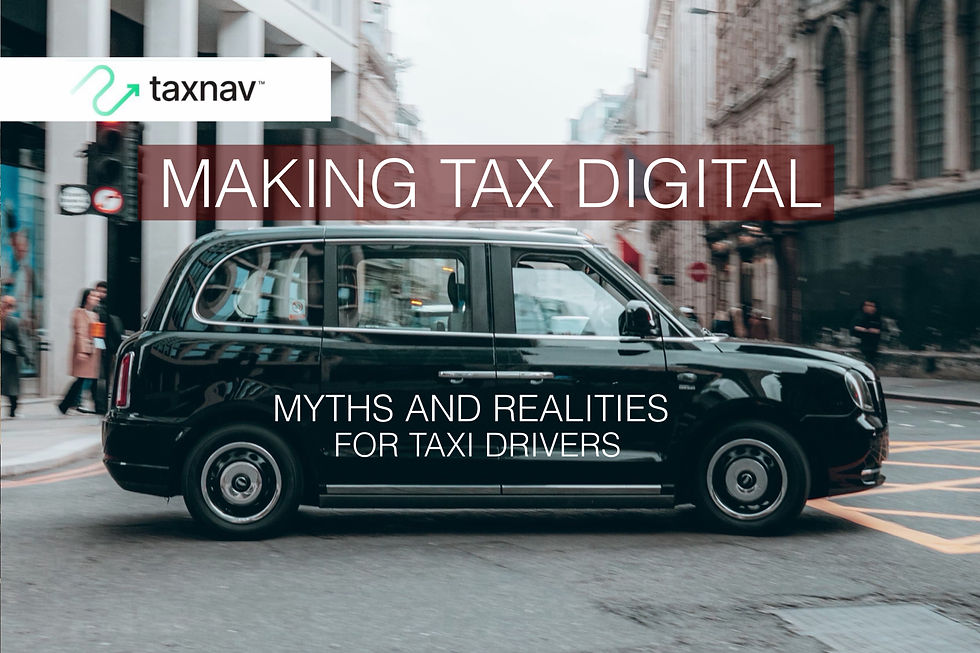

Making Tax Digital for Income Tax (MTD IT) is now a reality for many taxi and private hire drivers, but plenty of myths and misunderstandings still surround HMRC’s changes.
Since April 2026, MTD IT has applied to self-employed people and those with property rental income earning more than £50,000 a year. The threshold will reduce to £30,000 from April 2027 and £20,000 from April 2028, meaning many more drivers will be affected over the next two years.

The good news is that MTD IT is often much simpler than people expect. Let's separate myth from reality.
Myth 1: I need to become an accountant
Many taxi and private hire drivers worry that MTD IT will require detailed accounting knowledge. It doesn't.
If you currently keep paper records, you'll simply need to transfer your figures into a digital record, such as a spreadsheet or compatible software. If you already keep digital records, you're likely to be much closer to compliance than you think.
For most drivers, MTD IT requires year-to-date summaries of your income and expenses to be submitted to HMRC every quarter. You'll then complete a Final Declaration after the end of the tax year, which replaces the traditional Self Assessment tax return.
Many drivers find that simple HMRC-recognised software, such as TaxNav, helps them organise their records, either by entering their figures directly into the software or linking an existing spreadsheet.
Myth 2: HMRC is providing free software
Some drivers assume HMRC will provide its own MTD IT software. It won't. HMRC requires taxpayers to use compatible third- party software but does not provide a free filing platform itself.
If you're affected by MTD IT, you'll need to choose HMRC-recognised software and register correctly. You'll also need your National Insurance number when signing up and connecting your software to HMRC.
TaxNav was developed specifically to help taxi drivers and other self-employed people navigate MTD IT without accounting or tax knowledge. We were part of the HMRC MTD IT pilot last year and successfully completed more than 600 submissions.
Myth 3: I can't use a spreadsheet anymore
No, HMRC does not ban spreadsheets under MTD IT.
If you already use a spreadsheet to record your fares, fuel, insurance and other business costs, you can continue using it for MTD IT.
You’ll need to select HMRC-recognised bridging software to link your spreadsheet records to the MTD IT system. TaxNav, for instance, enables drivers to keep using spreadsheets while still complying with HMRC requirements and submitting quarterly updates digitally. With us, you can connect your own spreadsheet or choose from our MTD IT spreadsheets.
For many drivers, this means keeping the system they already know while becoming compliant with the new rules.

Myth 4: I have to submit every fare and receipt to HMRC
Quarterly updates do not require you to send HMRC every individual fare, fuel receipt or expense. Instead, you submit year-to-date totals for your business income and expenses every quarter.
You still need to keep digital records to support those figures, but the quarterly update itself is much simpler than people expect.
Myth 5: Quarterly updates mean quarterly tax bills
The quarterly updates are not tax bills, and they do not create a new tax payment deadline every three months.
Instead, they are year-to-date summaries of your income and expenses submitted during the tax year. Once submitted, you’ll gain an estimate of your likely tax position based on the information you've provided.
This can help drivers budget for future tax bills and avoid surprises. After the tax year ends, you'll complete a Final Declaration, which replaces the traditional Self Assessment tax return. Any tax due is still settled then, with the usual 31 January deadline.

Myth 6: I need to work out capital allowances every quarter
This is a concern for many drivers who have bought a vehicle for their business. The good news is that capital allowances do not form part of your quarterly updates. Your quarterly submissions only contain income and expense information.
Tax relief on business assets, such as a taxi or private hire vehicle, is dealt with later as part of your end-of-year tax adjustments and included in your Final Declaration.
There is no need to calculate capital allowances every three months. They are dealt with at the end of the tax year.
The reality
Making Tax Digital for Income Tax is a change, but it doesn't have to be difficult. Most taxi and private hire drivers already keep much of the information they need. The key difference is that records must now be kept digitally and submitted through HMRC-recognised software.
Once drivers understand what's actually required, MTD IT is often far less daunting than the myths suggest.
Article by TaxNav
TaxNav is HMRC-recognised software designed to make Making Tax Digital for Income Tax (MTD IT) compliance simple.