REMOVING THE DRIVER DOESN’T REMOVE THE PEOPLE: A driverless robot-cab still needs people, and somebody has to pay for them

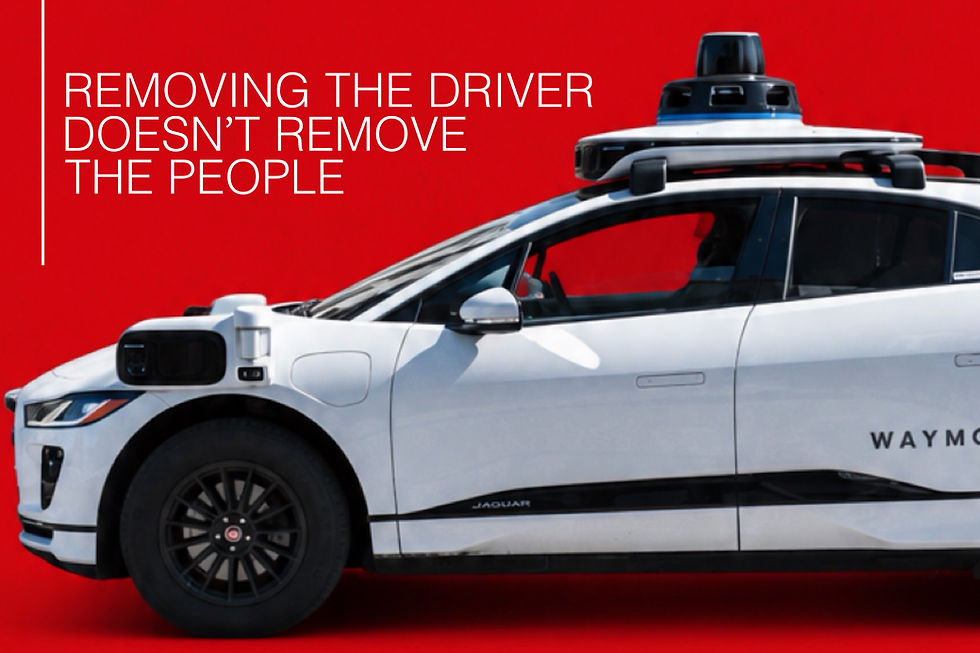

Removing the person behind the wheel does not remove the work involved in passenger assistance, vehicle recovery, cleaning, maintenance and dealing with unexpected incidents.
The long-term commercial promise of a driverless cab service is pretty straightforward: remove the driver and remove a substantial operating cost. It is an attractive proposition for technology companies and fleet investors, particularly in cities where passenger demand is concentrated.
But the calculation becomes considerably less impressive if it assumes the vehicle can operate indefinitely without human assistance. A taxi or private hire driver does rather more than steer, accelerate and brake.

Consider what happens during an ordinary working shift. Passengers ask questions, struggle with luggage, change their destinations, leave belongings behind or need assistance finding a safe pickup point. Vehicles require cleaning, charging, maintenance and occasionally recovery. Some of those tasks can be automated or handled remotely. Others require somebody to attend in person. Removing the driver changes how that work is delivered; it does not make the work disappear.
The Automated Vehicles Act 2024 provides the legal foundation for a new framework governing automated vehicles and passenger services in Great Britain. The Government's automated passenger services permitting scheme is intended to accommodate commercial operations and trials involving vehicles that may operate without a human driver. Its published proposals address safety, safeguarding, accessibility, local authority involvement and reporting obligations. These are regulatory foundations at this stage, not proof that a commercially viable driverless private hire services can operate everywhere.
The Department for Transport has specifically recognised the importance of older and disabled passengers in developing these services. The permitting framework includes requirements for operators to report on measures taken to meet their needs and safeguard passengers. That is important, but publishing a report is not the same as providing effective assistance at the roadside. An operator still needs a practical answer when a passenger cannot board, becomes distressed or needs help leaving the vehicle.
There is a huge commercial difference between remote customer support and physical intervention. A control centre may be able to speak to a passenger, change a booking or coordinate a response. It cannot lift a suitcase into the boot or physically assist somebody who needs help. A vehicle that cannot complete a journey without intervention may require a support team, another vehicle or a recovery contractor. Those resources have to be available within a reasonable distance if the service is to remain dependable.
Fleet economics therefore depend on more than the cost of the automated driving system. Investors need to account for vehicle purchase or leasing, insurance, cleaning, energy, maintenance, connectivity, customer support, remote operations and recovery. There may also be substantial costs associated mapping, software and compliance. Some of those costs should fall as technology matures. Others are ordinary transport-business expenses that will remain regardless of who controls the steering.
Operating density is another problem. A support team covering a compact city centre may be able to attend incidents relatively quickly. The same team serving scattered suburban or rural journeys could spend much of its time travelling between vehicles. This creates a familiar taxi-industry problem: empty mileage and waiting time. Automation may reduce one category of labour cost while introducing different forms of standby capacity and repositioning expense.
None of this establishes that autonomous vehicles will fail. Technology can improve rapidly, and a fleet operating within carefully chosen geographical and operating limits may eventually achieve attractive costs. Nor should conventional taxi operators assume that every task currently performed by a driver will always require the same level of human involvement.
For the licensed trade, the immediate lesson is that passenger transport remains an operational business. The vehicle must arrive, the customer must be able to use it and somebody must resolve problems when the journey does not proceed as expected. Driverless technology could change the economics of that service substantially over time.