.jpg)



What are the questions councils face as part of government taxi licensing consultation to redefine authority regions?

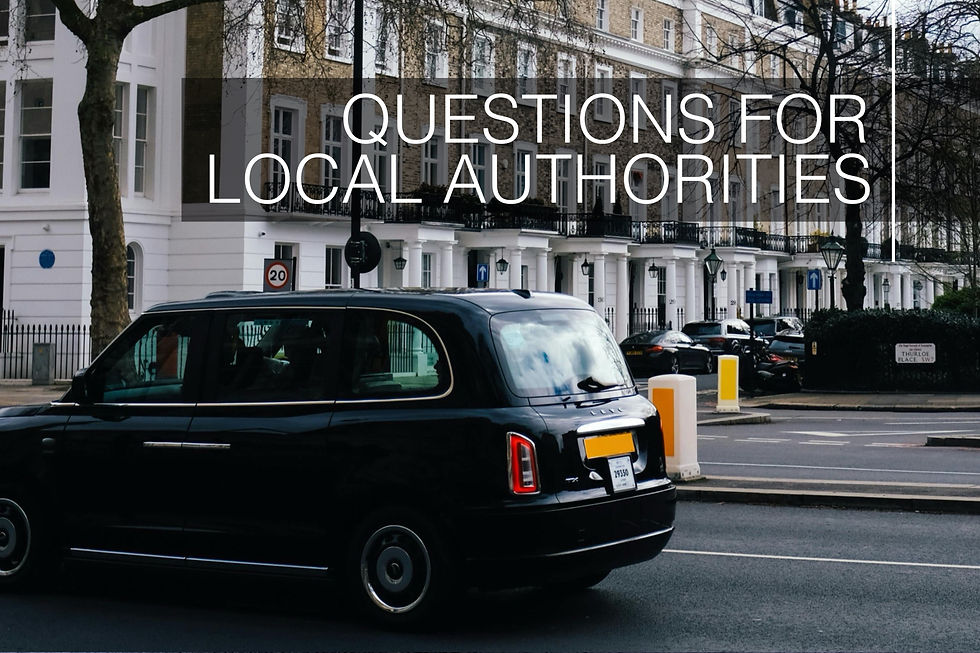

Local authorities are being pressed to account in detail for the financial, staffing and enforcement consequences of a proposed overhaul of taxi and private hire vehicle licensing, under a consultation launched by the Department for Transport that could reshape how the sector is regulated in England.
The consultation, which opened on 8 January and runs until 1 April 2026, examines whether responsibility for taxi and private hire licensing should be transferred from the current patchwork of district, unitary and metropolitan councils to local transport authorities. If implemented, the change would reduce the number of licensing authorities from 263 to around 70, aligning licensing with the same bodies responsible for producing statutory local transport plans.

Ministers argue that the current structure, rooted in legislation dating back to the mid nineteenth century, no longer reflects modern travel patterns or the way taxi and private hire services operate. Passengers routinely cross council boundaries for work, education and leisure, while drivers and operators increasingly licence in areas other than where they predominantly work. The Government says this “out of area” working complicates enforcement and creates incentives for drivers to seek licences based on cost or speed rather than local accountability.
Against that backdrop, the consultation is asking local authorities to respond to a tightly framed set of questions designed to expose the real-world implications of a shift to larger licensing footprints. For councils that already license taxis and private hire vehicles, the first four questions focus squarely on money and resources. Authorities are asked whether they would expect any one-off costs if licensing moved to local transport authorities, what those costs would relate to, and to quantify them either in pounds or staff hours. They are then asked the same about ongoing costs, followed by one-off savings and ongoing savings.
Ministers are asking local authorities to set out detailed financial and operational evidence as part of a proposal to move taxi and private hire licensing to local transport authorities across England
Although the questions appear technical, they go to the heart of how disruptive the transition could be. Councils are expected to consider costs associated with transferring staff, migrating IT systems, consolidating licensing databases, redesigning governance and committee structures, and managing transitional arrangements for drivers, vehicles and operators currently licensed under different regimes. Authorities that combine taxi licensing with other licensing functions, such as alcohol or gambling, may also need to assess the impact of losing a significant fee-funded service from a shared team.
A second set of questions targets local transport authorities that would take on licensing for the first time, including combined authorities and combined county authorities where they exist, as well as county councils and unitary authorities acting as LTAs elsewhere. These bodies are asked the same four questions on costs and savings, effectively testing the government’s assertion that larger licensing areas would deliver economies of scale, faster processing and more effective enforcement.
The consultation document repeatedly stresses that taxi and private hire licensing is intended to be self-funding, with fees raised from the sector rather than local taxpayers. Ministers acknowledge there may be one-off transitional costs, but argue that these should be offset over time by efficiencies from licensing larger numbers of drivers, vehicles and operators under a single authority. Councils are nevertheless being asked to provide evidence, rather than assumptions, about whether those savings would materialise and how quickly.
Beyond finance, the questions sit within a wider policy narrative around safety, consistency and enforcement. The Government points to long-standing concerns about inconsistent licensing standards and difficulties in regulating drivers who are licensed by one authority but operate primarily in another. While councils can prosecute certain offences regardless of where a licence was issued, only the licensing authority that granted a licence can suspend or revoke it. In areas with heavy cross-boundary working, this can slow down action when concerns arise.
The consultation argues that consolidating licensing at the local transport authority level would reduce the number of boundaries drivers regularly cross, increasing the proportion of vehicles and drivers working “in area” and therefore subject to the full enforcement powers of a single authority. It also suggests that larger authorities would be better placed to resource specialist compliance teams and to target enforcement activity around major events or demand spikes, where reliance on out-of-area vehicles is currently common.
These arguments are explicitly linked to wider government commitments on safeguarding and regulatory consistency. The consultation references recommendations made by Baroness Casey in her national audit on group-based child sexual exploitation and abuse, which highlighted risks arising from fragmented oversight. Ministers have also introduced amendments to legislation to enable the setting of national minimum standards for taxi and private hire licensing, signalling a broader move away from highly localised discretion.
In her foreword to the consultation, local transport minister Lilian Greenwood frames the proposal as “one potential, but incredibly significant” option among several being explored. She acknowledges that moving licensing away from existing authorities could be controversial, particularly for councils that have invested heavily in making the current system work, but says the Government wants to test whether aligning licensing with transport planning could deliver better outcomes for passenger safety and service reliability.
The consultation is closely tied to the Government’s devolution and local government reorganisation agenda, set out in the English Devolution White Paper. Over time, ministers want universal coverage of strategic authorities acting as local transport authorities. If that ambition is realised without reforming taxi licensing, the DfT notes that responsibility for licensing could end up sitting entirely outside the bodies that plan and coordinate local transport networks, apart from in London.

London itself is excluded from the proposals, as Transport for London already licenses taxis and private hire vehicles alongside its wider transport responsibilities. Outside the capital, however, the consultation makes clear that even if licensing is not moved to LTAs, ongoing local government reorganisation is likely to change which councils hold licensing powers, particularly in two-tier areas moving to unitary structures.
For local authorities responding to the consultation, the challenge will be to balance principle with pragmatism. The questions do not ask councils whether they like the idea of reform, but whether they can evidence its costs and benefits. Authorities will need to consider not just headline budget impacts, but also transitional risks such as policy harmonisation, treatment of existing licence holders, and the potential knock-on effects on local taxi markets, including fare setting, taxi zones and the size of compellable areas.
There is also an implicit expectation that councils will reflect on how licensing fits within wider transport objectives, such as decarbonisation, accessibility and integration with other modes. The government argues that placing licensing within LTAs would give those bodies direct control over policies affecting emissions standards and charging infrastructure, rather than relying on influence alone. Councils may be asked, formally or informally, to demonstrate whether that integration would deliver tangible benefits in their areas.
The consultation closes on 1 April 2026, after which the DfT has said it will publish a summary of responses and set out next steps. Whether the evidence provided by councils supports the Government’s case for consolidation, or highlights risks and costs that outweigh the proposed benefits, is likely to shape one of the most significant changes to taxi and private hire regulation in decades.