.jpg)



When can a taxi or private hire operator fairly charge for a cancelled booking or no-show?

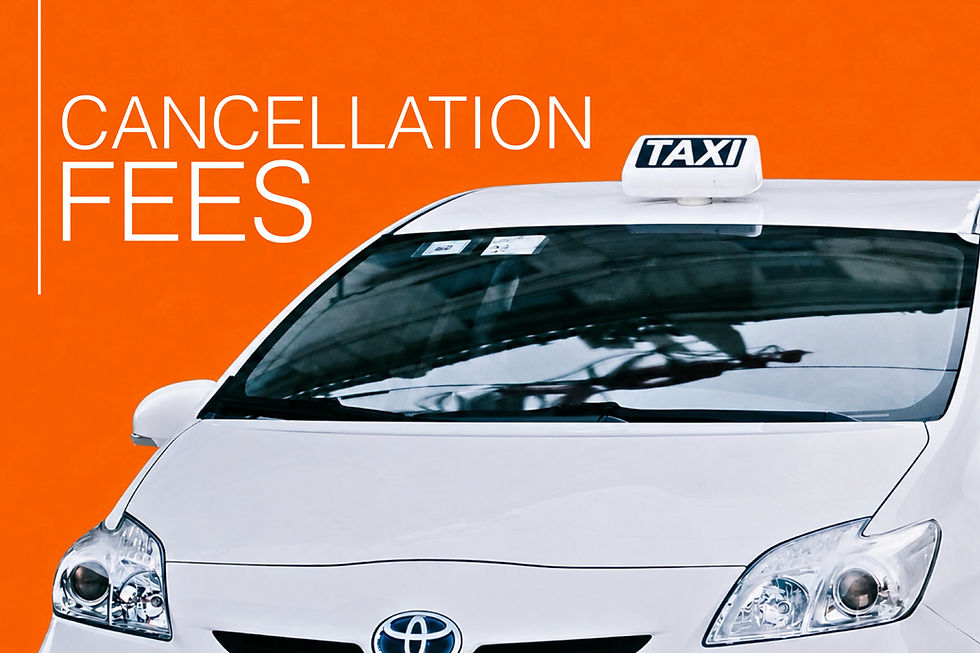

A driver can spend 20 minutes reaching a collection point, wait outside and leave without a passenger or fare. Treating that failed booking as commercially harmless would be absurd.
A cancellation charge can therefore have a legitimate purpose and compensate for wasted mileage, waiting time and the opportunity to accept another job.

That does not give an operator unlimited freedom to impose whatever figure its software permits. Consumer contract terms must be fair and transparent, and an unfair term is not binding simply because it appeared somewhere in an app or booking confirmation.
Competition and Markets Authority guidance says a business can protect itself when a customer cancels through no fault of the business. Any retained prepayment or cancellation charge should reflect the loss actually caused and the reasonable steps available to reduce it.
That principle fits private hire work particularly well because the loss changes as the booking progresses. A cancellation made hours before dispatch does not normally create the same cost as one made after the driver has reached an airport terminal.
A sliding policy can recognise those differences and an operator might allow free cancellation before allocation, apply a modest charge after the driver begins travelling or use a different calculation after an agreed waiting period expires.
The figures still needs a commercial basis around the mileage already driven, waiting time incurred, parking paid and work genuinely lost are more defensible foundations than a fee selected because it discourages complaints.
Operators must also consider mitigation. If the cancelled booking is immediately replaced by another passenger from the same location, recovering the complete original fare may compensate the business for a loss it did not ultimately suffer.
A deposit should not automatically become non-refundable in every circumstance. CMA consumer guidance says non-refundable deposits should generally represent only a small percentage of the total price, while cancellation charges should be genuine estimates of direct loss.
The passenger should know whether a charge applies and when the free-cancellation deadline ends. Finer details around when waiting begins, how long the driver will remain and what counts as a no-show also needs to be clear with the customer. Hiding those terms behind several links weakens the operator’s position. Consumer law gives particular importance to terms being expressed clearly and brought to the customer’s attention appropriately.

Where an order carries an obligation to pay, the relevant information must be presented prominently before the customer places it. Location data is not always proof that the driver was ready to collect. A GPS marker may be on the wrong side of a station, outside a restricted airport zone or at an entrance inaccessible to the passenger.
Operators should therefore define arrival properly and record such things as time and location, driver contact attempts, passenger messages and any instructions governing the meeting point.
A sensible appeal process should also be present because automation makes mistakes. Passengers should be able to challenge the charge without navigating an endless series of menus, and staff should have authority to examine the actual booking rather than repeat the app’s conclusion.
A fair cancellation policy protects vehicle supply as well as consumers. Drivers are less likely to accept advance bookings when they repeatedly carry the entire cost of passengers who disappear.
The strongest policy is not necessarily the strictest. It is the one passengers can understand, drivers consider worthwhile and the operator can justify from the real loss surrounding each cancelled journey.