.jpg)



ACCESSIBLE BY LAW, UNAVAILABLE IN REALITY: Wheelchair taxis and PHV under pressure as government signals tougher action on accessibility

Updated: Jan 26
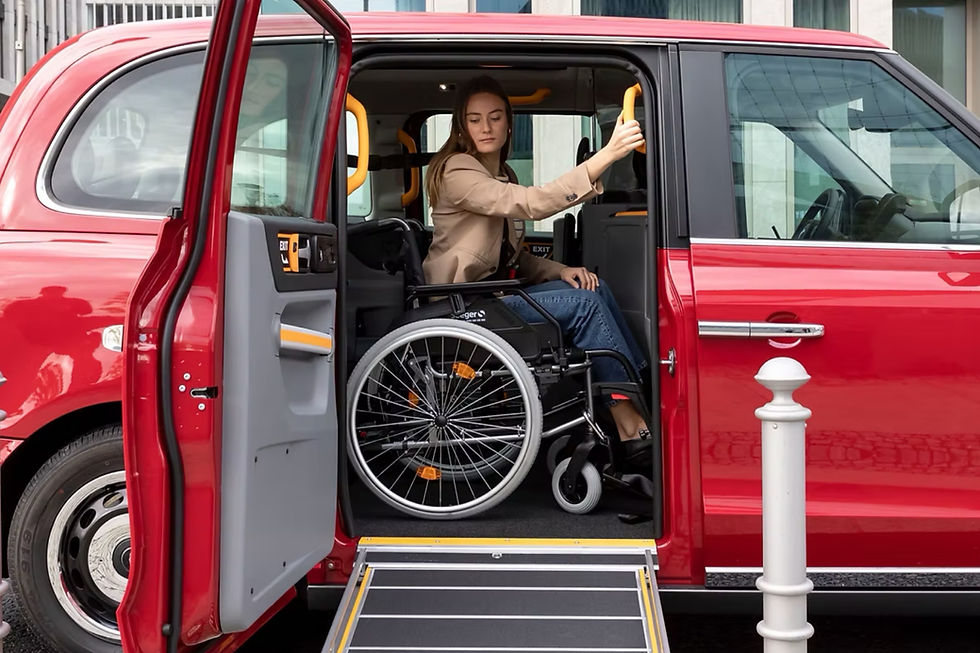

The UK Government has signalled that stronger intervention may be required to address persistent shortages of wheelchair accessible taxis and private hire vehicles, after senior ministers accepted that current licensing arrangements are failing to deliver consistent access for disabled passengers.
Giving evidence to the House of Commons Transport Committee, Transport Minister Lilian Greenwood MP said the availability of wheelchair accessible vehicles remains inadequate in many parts of the country, particularly within private hire fleets, and confirmed the issue would be examined as part of forthcoming national minimum standards for taxi and private hire licensing.

“We want there to be sufficient wheelchair accessible vehicles that serve the needs of disabled people who want them,” Greenwood told MPs. “I do not want people to be in a position where they cannot access a vehicle that meets their needs and enables them to do the journeys they want to do.”
The evidence session exposed what several MPs described as a structural market failure, with wheelchair users frequently unable to secure vehicles at short notice and, in some cases, forced to plan journeys days in advance. The problem was highlighted as being most acute within private hire vehicle fleets, where wheelchair accessible vehicles make up only a small proportion of licensed cars, despite rising demand.
Ministers acknowledge market failure as evidence highlights shortages of wheelchair accessible vehicles across taxi and private hire fleets
Liz Wilson, Deputy Director for Accessibility, Coaches, Taxis and Community Transport at the Department for Transport, told the Committee that while some urban taxi fleets provide reasonable coverage, provision drops sharply outside major cities and within app-based private hire services. “The problem is most acute in private hire vehicles, where there is a much lower percentage of them,” she said. “It is therefore probably felt most acutely in rural areas.”
Data submitted to the inquiry showed significant variation between licensing authorities, with some areas mandating high proportions of wheelchair accessible taxis while others impose no such requirement. Wolverhampton, one of the largest licensing authorities by volume, was cited as having a particularly low proportion of wheelchair accessible private hire vehicles, despite issuing thousands of licences each year.
Greenwood rejected suggestions that the issue could be solved simply by mandating full fleet accessibility, warning that such an approach could have unintended consequences. “There are some local authorities that require their entire taxi fleet to be wheelchair accessible, but that might not be necessary or able to be provided everywhere,” she said. “We know that wheelchair accessible vehicles are expensive to provide.”
The cost of wheelchair accessible vehicles remains a central challenge. Purpose-built vehicles can cost several times more than standard saloon cars, placing a heavy burden on owner-drivers who typically finance vehicles themselves and often work across multiple platforms. Greenwood cautioned that blunt regulatory requirements could push drivers away from the taxi trade altogether.
“If you put in a requirement that you want a certain proportion of your taxis to be wheelchair accessible, the worry is that that might displace people to decide, ‘Well, I’m not going to drive a taxi, I’m going to change to driving a PHV,’” she said.
Despite these concerns, MPs argued that the current situation leaves disabled passengers paying the price for regulatory inaction. Dr Scott Arthur told the session that reliance on voluntary measures and operator goodwill had failed to deliver results. “This is a market failure,” he said. “There is more the Government could do, because I did not get the feeling that operators were going to act in this area without guidance or perhaps something a bit firmer from the Government.”
Arthur also rejected arguments that higher costs justified limited provision, drawing comparisons with accessibility requirements in other parts of public life. “We accept that we want to spend a little more to create that more equal society,” he said, adding that most passengers would be willing to pay slightly more for inclusive transport if it ensured availability for wheelchair users.
The Minister acknowledged that accessibility cannot be left solely to market forces, but stopped short of committing to specific quotas or national mandates. Instead, she indicated that a mix of regulatory levers, incentives and licensing reform would be explored. “We need to find what the right mechanisms are,” Greenwood said. “It is probably a bit of a mixture of carrot and stick.”

Officials confirmed that accessibility would be a core pillar of proposed national minimum standards, alongside safeguarding and safety. Disability equality training is expected to become mandatory for all taxi and private hire drivers, with ministers describing current uptake as “unacceptable”. Wilson told MPs that only around two-thirds of licensing authorities currently require such training.
The Department is also examining whether licensing authorities should be required to take a more proactive role in monitoring refusals and unmet demand, rather than relying on complaints from disabled passengers. Greenwood said it was “simply unacceptable” that guide dog users and wheelchair users continue to face refusals and poor service, suggesting that enforcement has not been effective enough.
For the taxi and private hire industry, the direction of travel suggests increased scrutiny of accessibility outcomes rather than inputs alone. While ministers remain wary of imposing rigid national quotas, the emphasis on sufficiency of provision, unmet demand and consistency across licensing areas is likely to place pressure on operators and authorities with low levels of accessible vehicles.
Greenwood confirmed that the Department will take away the Committee’s evidence and examine further options to address the cost gap between accessible and non-accessible vehicles. “We very much share the aspiration that we want to ensure that disabled people have the opportunities,” she said. “Including wheelchair users, absolutely.”
Consultation on national minimum standards is expected to follow the passage of the English Devolution and Community Empowerment Bill later this year. While timelines remain uncertain, ministers indicated that accessibility reforms would not be delayed indefinitely. “This issue has been knocking around for a number of years now,” Greenwood told MPs. “It is time that there was action.”